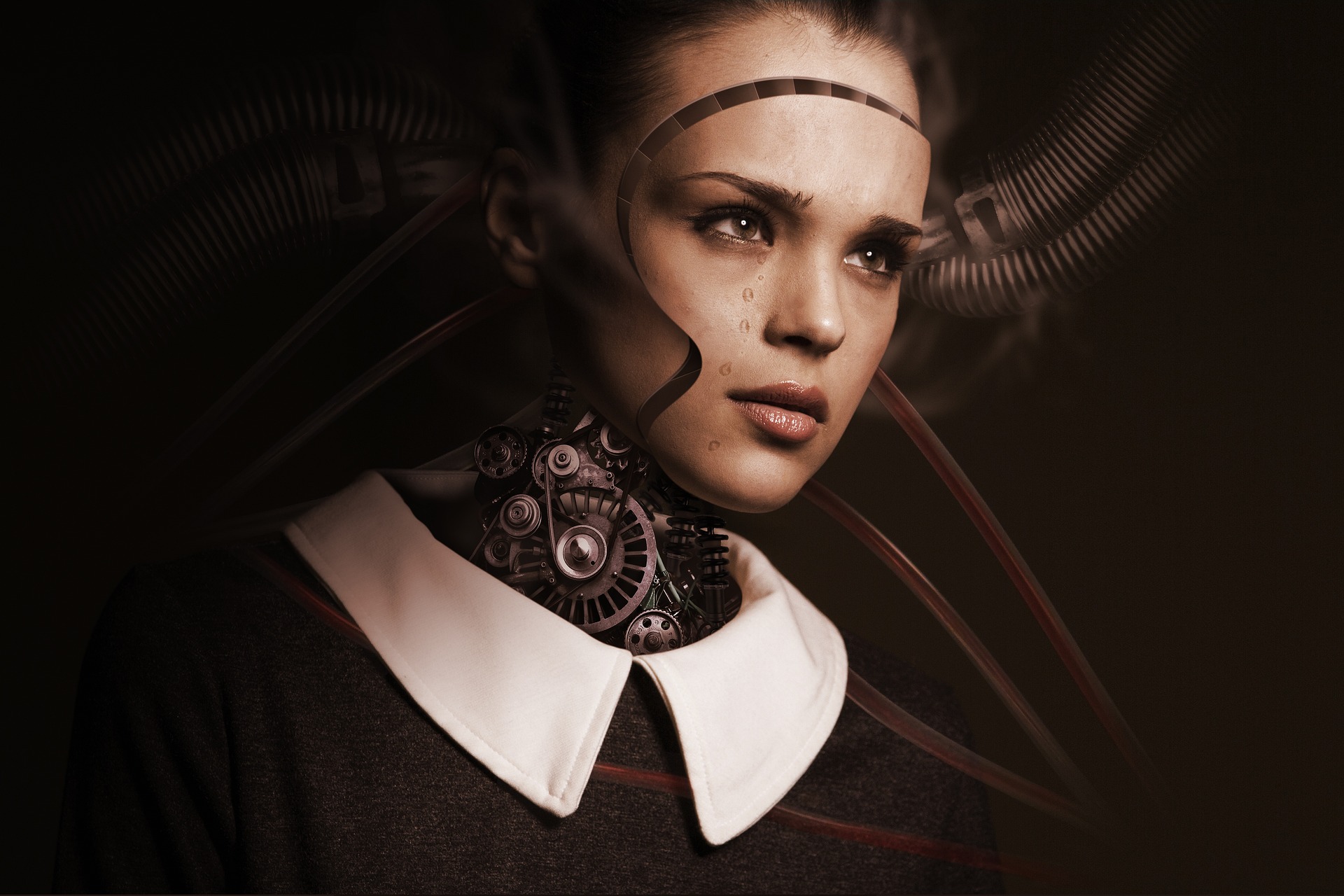
Artificial Intelligence (AI) refers to the simulation of human intelligence in machines that are programmed to think and act like humans. It involves the development of algorithms and computer programs that can perform tasks that typically require human intelligence such as visual perception, speech recognition, decision-making, and language translation. AI has the potential to revolutionize many industries and has a wide range of applications, from virtual personal assistants to self-driving cars.
Before leading to the meaning of artificial intelligence let understand what is the meaning of Intelligence-
Intelligence: The ability to learn and solve problems. This definition is taken from webster’s Dictionary.
The most common answer that one expects is “to make computers intelligent so that they can act intelligently!”, but the question is how much intelligent? How can one judge intelligence?
…as intelligent as humans. If the computers can, somehow, solve real-world problems, by improving on their own from past experiences, they would be called “intelligent”.
Thus, the AI systems are more generic(rather than specific), can “think” and are more flexible.
Intelligence, as we know, is the ability to acquire and apply knowledge. Knowledge is the information acquired through experience. Experience is the knowledge gained through exposure(training). Summing the terms up, we get artificial intelligence as the “copy of something natural(i.e., human beings) ‘WHO’ is capable of acquiring and applying the information it has gained through exposure.”
Table of Contents
- Intelligence is composed of:
- Uses of Artificial Intelligence :
- Need for Artificial Intelligence
- Drawbacks of Artificial Intelligence :
- Technologies Based on Artificial Intelligence:
Intelligence is composed of:
- Reasoning
- Learning
- Problem-Solving
- Perception
- Linguistic Intelligence
Many tools are used in AI, including versions of search and mathematical optimization, logic, and methods based on probability and economics. The AI field draws upon computer science, mathematics, psychology, linguistics, philosophy, neuroscience, artificial psychology, and many others.
The main focus of artificial intelligence is towards understanding human behavior and performance. This can be done by creating computers with human-like intelligence and capabilities. This includes natural language processing, facial analysis and robotics. The main applications of AI are in military, healthcare, and computing; however, it’s expected that these applications will start soon and become part of our everyday lives.
Many theorists believe that computers will one day surpass human intelligence; they’ll be able to learn faster, process information more effectively and make decisions faster than humans. However, it’s still a work in progress as there are many limitations to how much artificial intelligence is achieved. For example, computers don’t perform well in dangerous or cold environments; they also struggle with physical tasks such as driving cars or operating heavy machinery. Even so, there are many exciting things ahead for artificial intelligence!
Uses of Artificial Intelligence :
Healthcare:
AI is used for medical diagnosis, drug discovery, and predictive analysis of diseases.
Finance:
AI helps in credit scoring, fraud detection, and financial forecasting.
Retail:
AI is used for product recommendations, price optimization, and supply chain management.
Manufacturing:
AI helps in quality control, predictive maintenance, and production optimization.
Transportation:
AI is used for autonomous vehicles, traffic prediction, and route optimization.

Need for Artificial Intelligence
- To create expert systems that exhibit intelligent behavior with the capability to learn, demonstrate, explain, and advise its users.
- Helping machines find solutions to complex problems like humans do and applying them as algorithms in a computer-friendly manner.
Drawbacks of Artificial Intelligence :
- Bias and unfairness: AI systems can perpetuate and amplify existing biases in data and decision-making.
- Lack of transparency and accountability: Complex AI systems can be difficult to understand and interpret, making it challenging to determine how decisions are being made.
- Job displacement: AI has the potential to automate many jobs, leading to job loss and a need for reskilling.
- Security and privacy risks: AI systems can be vulnerable to hacking and other security threats, and may also pose privacy risks by collecting and using personal data.
- Ethical concerns: AI raises important ethical questions about the use of technology for decision-making, including issues related to autonomy, accountability, and human dignity.
Technologies Based on Artificial Intelligence:
- Machine Learning: A subfield of AI that uses algorithms to enable systems to learn from data and make predictions or decisions without being explicitly programmed.
- Natural Language Processing (NLP): A branch of AI that focuses on enabling computers to understand, interpret, and generate human language.
- Computer Vision: A field of AI that deals with the processing and analysis of visual information using computer algorithms.
- Robotics: AI-powered robots and automation systems that can perform tasks in manufacturing, healthcare, retail, and other industries.
- Neural Networks: A type of machine learning algorithm modeled after the structure and function of the human brain.
- Expert Systems: AI systems that mimic the decision-making ability of a human expert in a specific field.
- Chatbots: AI-powered virtual assistants that can interact with users through text-based or voice-based interfaces.